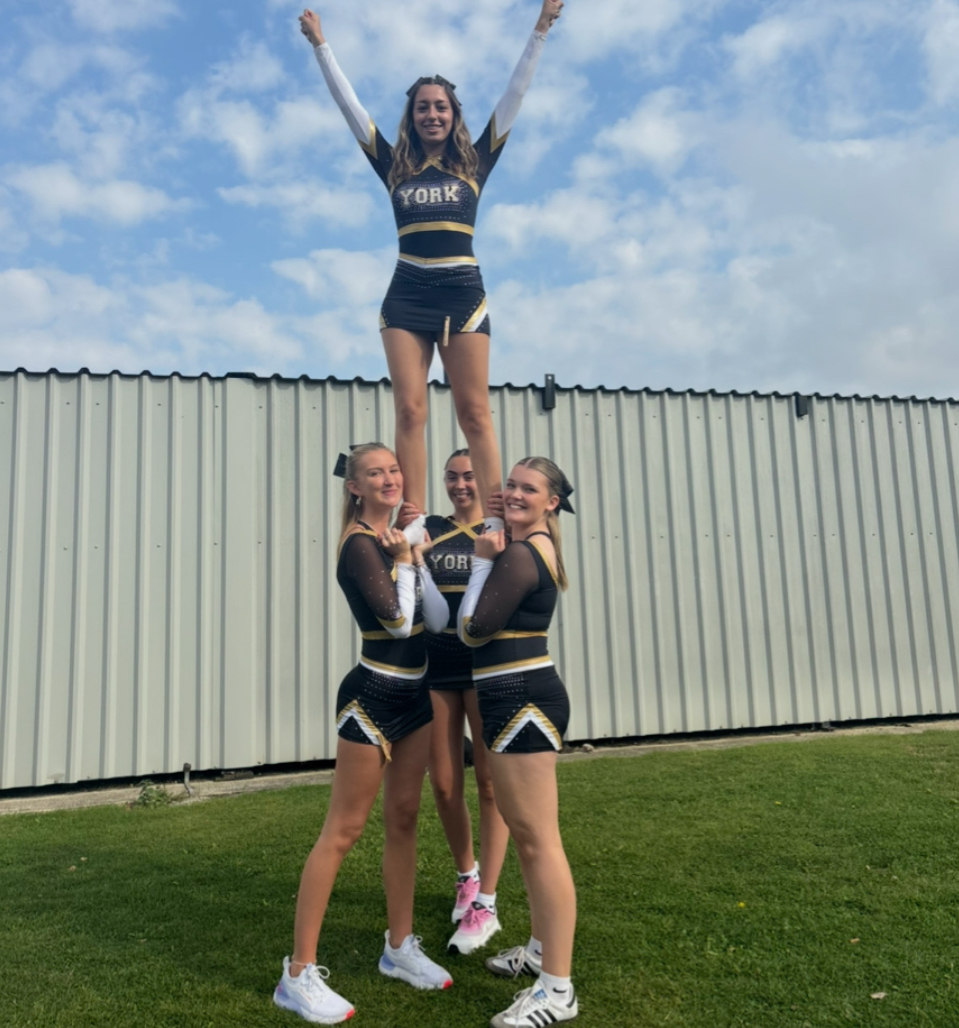
For decades the stereotypical cheerleader has been imprinted in our brains and became inspiration for countless films that shaped our childhood: the gorgeous popular girl who waves her pom-poms and struts about at the American football game covered in bows and glitter.
We were shown Megan Fox in Jennifer’s Body flirtatiously dancing in her iconic cheer uniform, Quinn Fabray strutting in the hallways with her pom-poms in Glee, and a series of movies of Bring It On where the school gymnasium becomes a glitter covered battleground for Kirsten Dunst. This comically feminine portrayal in pop culture has led many to undermine and patronise the sport; often we are led to believe that all cheerleading entails is looking pretty in skirts and leotards.
While the appearances play a part, the physical intensity and demand of the sport is often overlooked in favour of the glitz and glamour. That stereotype has stuck so stubbornly that even in the professional world, cheerleaders have historically been shockingly underpaid. The Dallas Cowboys Cheerleaders, arguably the most famous squad on the planet, were making below the minimum wage until a recent Netflix documentary, America’s Sweethearts: Dallas Cowboys Cheerleaders, finally pushed the franchise to give them a long-overdue raise. Even their sudden pay rise didn’t come from valuing their athleticism: it came because millions watched their brutal training, emotional strain, and physical demands on TV for the first time.
Speaking to Hollie Manly and Holly Foster, who have been part of University of York’s Hornets for three years and served as co-captains for one of the competitive teams last year, I was given a clear insight into how physically and mentally intensive the sport can be. “Our athletes train SO hard, first thing in the morning and last thing at night”, they said. “The sport demands so much physical strength and stamina. We train two or three times a week for about 4-5 hours every week. Training is with the whole team and involves stretching, conditioning, learning dance choreo, practising jumps and stunts.”
Along with the intense training, the mental demand of the sport plays a huge impact on the cheerleaders. Keeping up with the pressures of training, perfecting routines, and getting ready for competitions, it can be both mentally and physically taxing to balance studying, social lives, and the demands of the sport all at once. “Cheer is such a demanding sport and can be very tough sometimes, both mentally and physically,” Hollie stated, talking about the pressures she faced as captain during competition season. “I felt very responsible for the wellbeing of the whole team and really did not want to let anyone down. It was very easy to put too much pressure on myself over this period and I saw this translate both inside of cheer and into day to day life.”
For some, the pressures and stress of cheer take a tangible physical toll. The threat of injury constantly looms over every cheerleader; one wrong jump or a mistimed stunt can lead to serious consequences. In October 2024, this became reality for last year’s captain Holly Foster, who suffered a severe broken collarbone while performing a stunt she had executed countless times before.
“I fell backwards onto my shoulder on the floor. I had fallen from stunts many times before so immediately just tried to get straight up. I thought I had just winded myself, but when I tried to get up, I couldn’t and realised how much pain I was in,” Holly recalled. She was driven to A&E, spending the entire night at the hospital. Hoping she had only pulled a muscle or dislocated her shoulder, Holly soon discovered the injury was far more severe – her x-ray “showed a collarbone broken in four places,” shocking even the doctors. “The x-ray technician even audibly said ‘yikes’ when doing my x-ray,” she said.
The weeks that followed were gruelling. Holly decided against surgery, opting instead for eight weeks of rehab exercises and frequent check-ups, and she was absent from University for four weeks. The injury took around four months to fully heal. Throughout the ordeal, the unwavering support of her team became a lifeline. “Hornets members were so supportive and were always checking in on me, dropping round flowers, cards, and chocolates, which was so lovely,” Holly said. What could have been a lonely and isolating experience became one of reassurance, encouragement, and belonging, showing just how deeply the Hornets community supports its athletes.
A year on, Holly has returned fully to cheer, including stunting, though her collarbone still bears a permanent mark. “Fortunately, I found that people did take my injury seriously, but I think it made them realise how dangerous and demanding cheer can be, and made them see it as a ‘serious’ and ‘proper’ sport.” Holly’s journey highlights not only the physical risks cheerleaders face but also the resilience, dedication, and strength that define the sport – a reality far removed from the glittery stereotypes portrayed on screen
But despite the blood, sweat, and tears left behind on the training mat, not everything is so brutal when it comes to the sport. For many, it is a place of encouragement and belonging where friendships that long outlast university are formed.
Having met her best friends and some housemates through Hornets, Hollie Manly described the role cheer has played in helping her settle into university life and to find a community to rely on, literally and emotionally: “As a fresher, I was really struggling to settle into University life and was quite unhappy at times. The Hornets was such a great place to be able to meet older girls at the Uni who could give me advice and act as big sisters throughout my whole university experience – these are still girls I speak to all the time now!”
That support system cheerleading provided not only benefitted her socially, the consistency, encouragement and both physical and emotional support also had a profound impact on confidence and mental wellbeing. Hollie described cheerleading as “fundamental in building confidence throughout the last three years” and “an amazing outlet for releasing stress”.
Reflecting back on her three tumultuous but incredibly rewarding years at Hornets, which included a collarbone broken in four places, eight weeks of rehab exercises, and four months of healing, even all these challenges never outweighed the devotion and passion. “I think if anything, my injury made me love cheerleading more,” Holly Foster admitted. “The support I received from the Hornets during my injury and recovery made me realise how special of a sport cheerleading is. I did hesitate to return, and wasn’t sure if the risk of being injured again was worth it, but I love cheer so much and couldn’t imagine my uni experience without it.”
If it takes a documentary or even fair pay to convince the world that cheerleaders deserve respect and recognition, then maybe we’ve all been looking in the wrong direction. The Hornets might not have the stadium lights, 90,000 people watching and cheering, or a highly rated Netflix show, but their commitment, their injuries, and their dedication tell the same story: cheerleading is a serious sport with serious athletes.