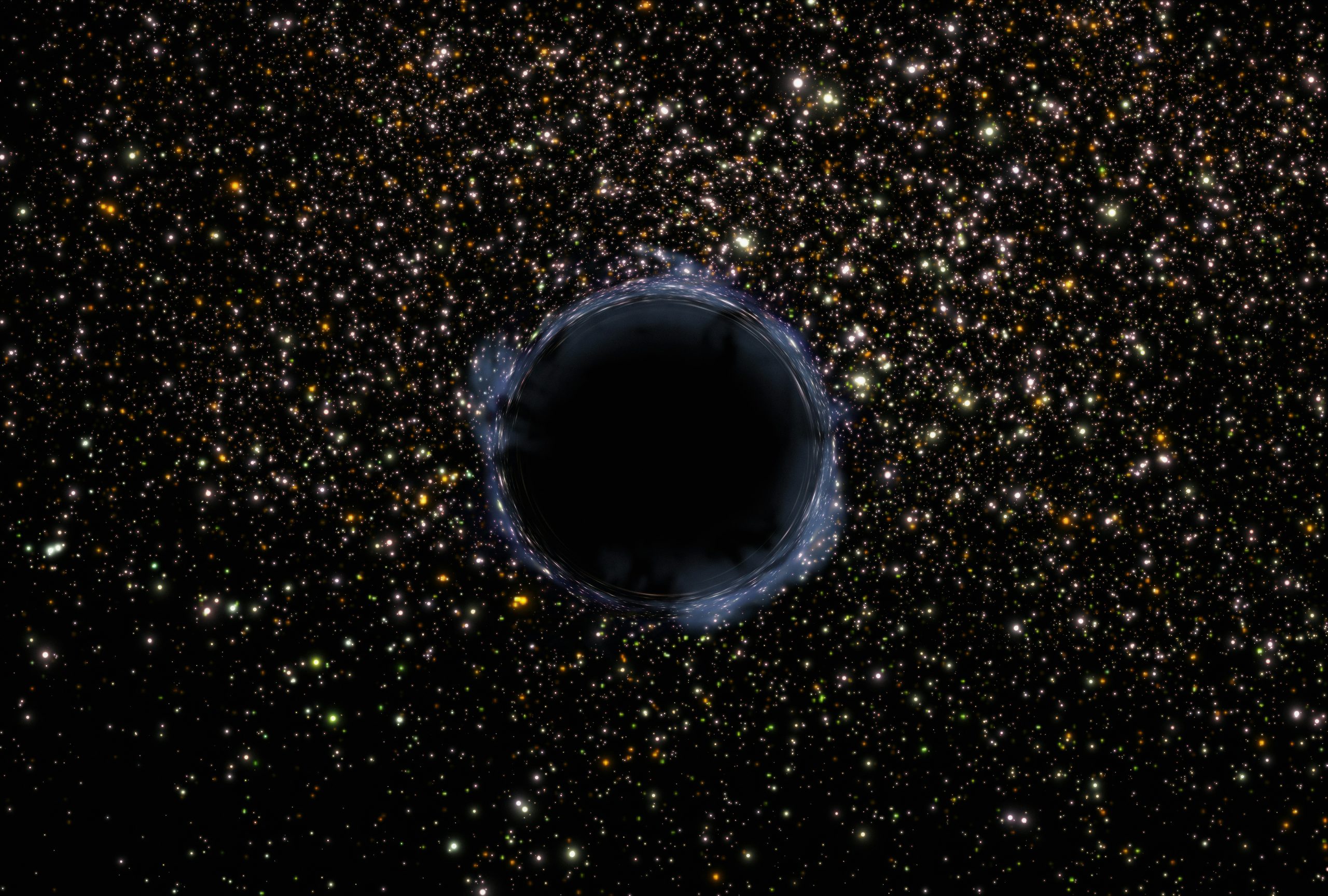
New research into the mass of an ancient galaxy, questions our entire understanding of the formation of the universe.
Supermassive black holes are black holes with masses billions of times larger than our sun. They are found at the center of most galaxies and date back to the Big Bang, some estimated to be over 13 billion years old. As a result, studying these phenomena may hold the key to understanding how the early universe was formed.
In a recent study, researchers at the University of Southampton investigated a supermassive black hole using a telescope called GRAVITY, which combines light from four different telescopes to achieve high resolution data. To calculate the mass of this black hole, scientists looked at a quasar (a very old galaxy) and studied the motion of gas around the centre.
They calculated that it has a mass of 800 million solar masses. This result was unexpected because when estimating the mass of this black hole using theoretical models and scaling laws, the expected mass is 8 billion solar masses. Though still an enormous size, the difference in observed mass compared to what theory predicts is staggering.
This discovery raises concerns about the validity of scaling laws that scientists use to estimate the masses of supermassive black holes. In turn, it suggests that our theoretical models about how the early universe was formed may need to be re-evaluated.
Access the full study here: https://arxiv.org/abs/2509.13911