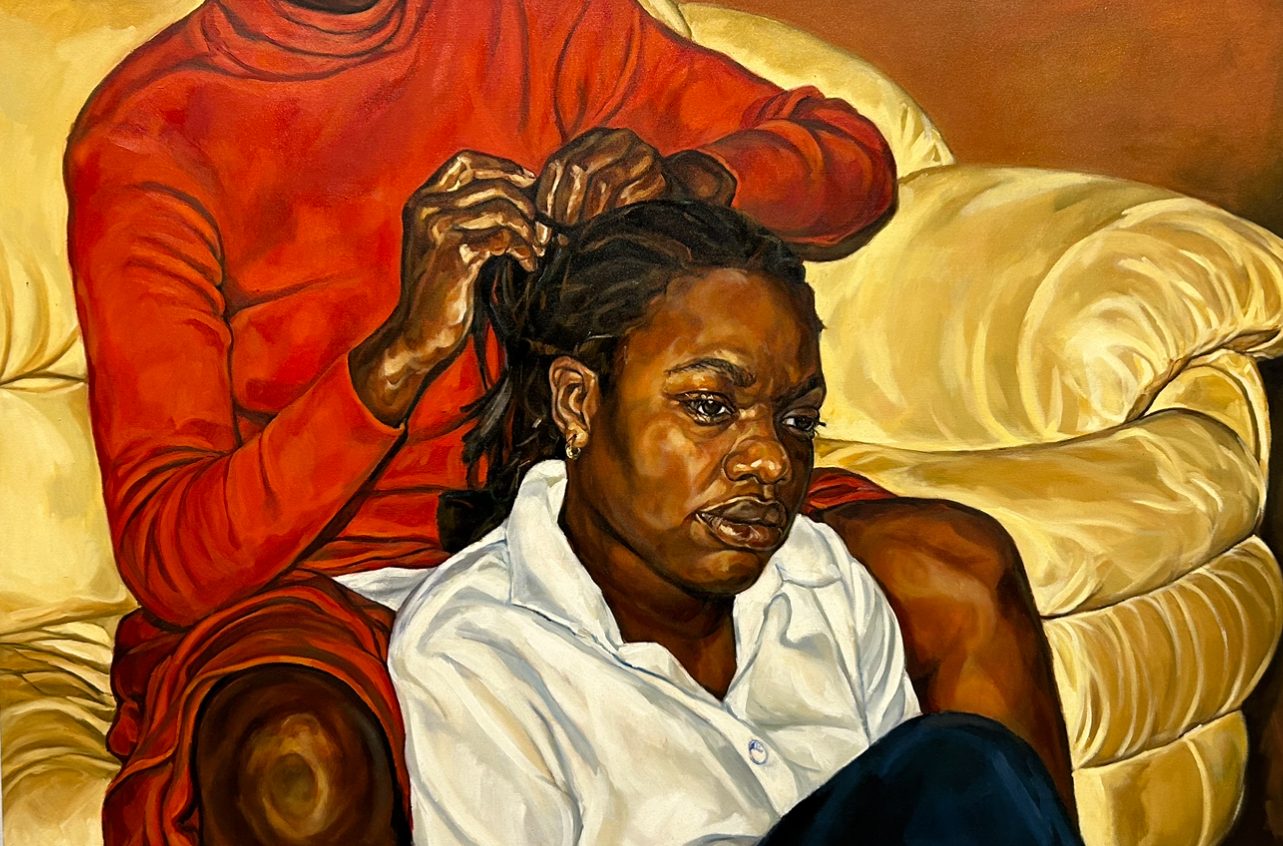
Barbara Walker’s newest exhibit is located in the Arnolfini gallery in Bristol and showcases her collection entitled ‘Being Here’. The artwork includes a series of paintings which examine the experience of black people during the Windrush Scandal and highlights the fears and discrimination that they experienced and how it affected generations of families at the time.
The Windrush Scandal is a British Political scandal that was exposed in 2018, it refers to the mistreatment of Caribbean immigrants and their descendants who arrived in the UK between 1948 and 1973. Despite having had the legal right to live and work, many were then wrongly denied these rights, detained and in a few cases, deported. The scandal wasn’t exposed until 2018, then compensation and proof of residency was organised for the affected families and individuals.
The Home Office had failed to accurately record the people who settled in the ‘Windrush Generation’, meaning they struggled to find the legal documents demanded of them to prove their status. The denial of rights that followed also led to people having no access to employment, healthcare or housing.
In her exhibition Walker says “I love working with people who are not used to having their voices heard. People who are often made visible in the worst ways. I want to help make people visible in the best ways possible, by creating affirming images that speak of and to humanity.”
You can see this through her work as she uses charcoal to draw faces of the afflicted on a background of reimagined legal documents and certificates. The merging of identity and race and what it meant for these people who called the UK home but were forced to question what they had known as their surroundings. She draws the faces with forlorn expressions and moments in thought as they reflect on the oppression they and their ancestors faced that was overlooked and disputed for so long.
She focuses on the UK’s immigration policies through the years and how it affects people who are forced to prove why they deserve to live where they have always lived or moved to as a form of refuge. Aswell as certificates, she layers her art on top of letters from UK employers, descriptions from army posts and anything that was available to make their lives ‘visible’ in a sense to the British Government. Almost being forced to question the validity of their existence and undergo what is coined as the ‘Life in The UK’ test.
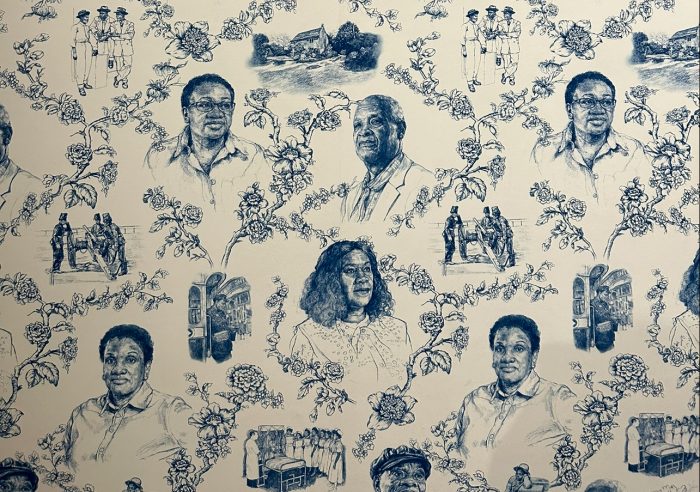
Within her ‘Windrush’ collection Walker also creates a wallpaper design that coats four walls of a small room when you enter the exhibit. It is so intricate in its detail you don’t initially notice the vastness of pattern and character of? the people that are repeated and cover the room. She entitles the paper ‘Soft Power’ (2024), it is made up of 13 repeated graphite drawings. The drawings depict first and second generation Windrush migrants emerging between a traditional ‘toile de jouy’ pattern. The pattern was quintessential to wallpapers of the upper and middle classes between 1760-1830 and Walker highlights the Caribbean faces against this traditional upper-class backdrop. Creating a sort of artistic justice, she was quoted saying, these people are made ‘visible, validated and centre stage where they belong.’
Walker has been recognised for the political exploration in her art and emphasising the ancestral and ongoing tension between identity, society and state for black migrants.
Her collection called ‘Burden of Proof’ (2022-23) was nominated for the Turner Prize and her work has become increasingly renowned for its impactful, emotive messaging.
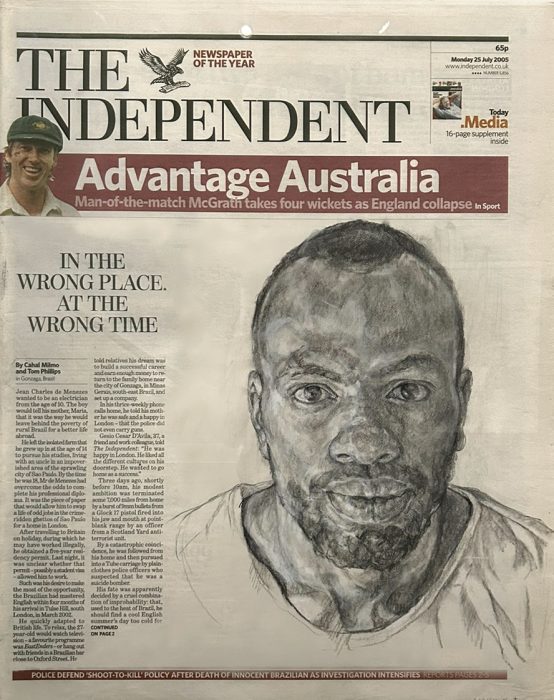
Some of Walter’s older artwork which was also on display covered additional themes of black culture, portraying the unlawful police brutality directed at innocent black individuals. Two of the artworks that do this are entitled, ‘Brighter Future 1’ and ‘Brighter Future 2’ (2006). They portray the face of a man staring straight out of the canvas with heavy eyes. He is looking out of the painting from a backdrop of a news article from the ‘Independent’ which reads the chilling headline, ‘In The Wrong Place at The Wrong Time’. This relates to the story of a 27 year old Brazilian man, Jean Charles de Menezes, who was wrongfully shot by the London Metropolitan police. She intertwines her personal story and the words of his parents into the dialogue of the backdrop.
I was fascinated by Walker’s mixed media art style and enlightened by many of her works. I found her work motivating and powerful and felt as though I was immersed in a host of history and creativity.
If you happen to find yourself in Bristol in the coming weeks, I think it is imperative you visit her exhibition!