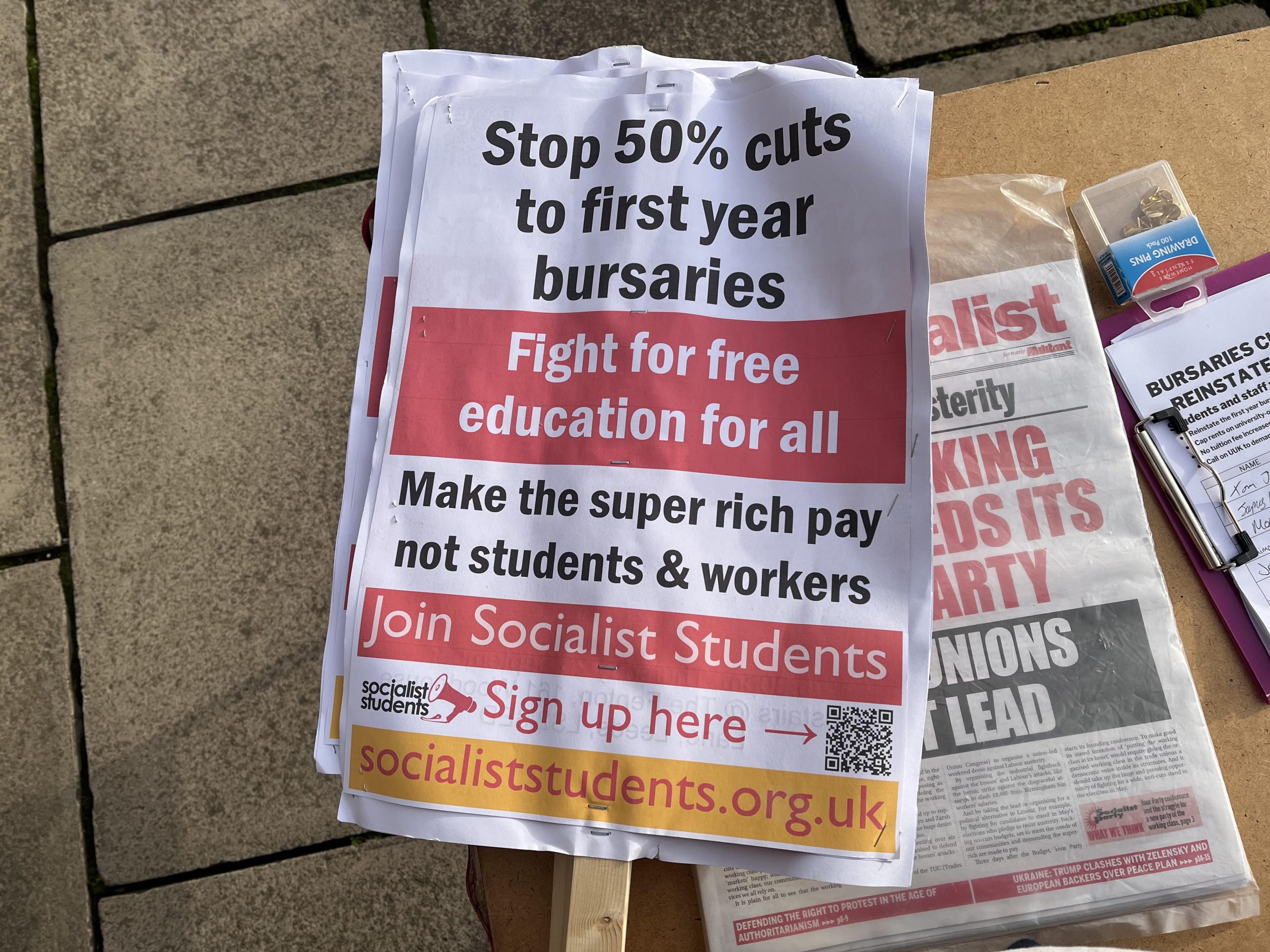
Students and academic staff assembled at Greg’s Place on Campus West to protest the University’s significant cutback of a bursary designed to help students from low-income backgrounds come to York.
At midday on Wednesday – bracing the chilling December winds – several political groups, including York Student Action Network Students, York Socialists Students and York’s Your Party (a relatively new addition to the scene of political-activism societies) rallied to protest this cut.
The first-year bursary is given to undergraduate home students coming from a household income of less than £35,000pa.
This bursary fits into the University of York’s wider mission to become “the University of Opportunity”.
The University has expressed a “lifelong commitment” to creating an environment where all students – regardless of their financial barriers – can access higher education and excel at their studies. The University has said it is determined to ensure equal access to educational opportunities, especially students facing socio-economic barriers.
But the bursary, which directly contributes towards this expressed commitment to support low-income students, was recently cut from £2000 to £1000. This leaves vulnerable students without the support they desperately need.
One protestor, who wanted to remain anonymous, claimed that these bursary cuts were “a massive attack” and that they were “putting a massive barrier between young people who just want to get started at University.”
A University spokesperson stressed: “By reducing the overall amount we give to individual students, we will be able to provide support to a higher number from lower-income backgrounds.
“We understand the concerns raised by our students and want to reassure our community that we take seriously our responsibility to ensure that financial means are not a barrier to studying.”
These bursary changes apply to students starting this academic year and not continuing students.
The University advised the Students’ Union in February regarding changes to bursaries for the 2025/26 academic year.
But the decision to reduce the amount of financial aid offered to students was notably published the the day after the UCAS application for offer decisions. York Student Action pointed this out on Instagram.
One student, Izzy, graduated from the University of York in last year with a 1st class degree in BA Economics and Philosophy, as well as the prestigious Chancellor’s Leadership Prize. Now working at a management consultancy firm, she said that receiving the bursary was “life-changing.”
When she was considering her options for higher education, she said: “I knew that if I was going to go to university, not only would I want it to be York, but financially, and feasibly, it could only ever be York.”
“I couldn’t have afforded to be a student anywhere else,” she said.
At a time when York’s housing market looks to be veering into crisis, protestors pointed out that low-income students need the full financial support of this bursary more than ever.
Rents for private student accommodation are skyrocketing, whilst maintenance loans are lagging behind, in what the Union Affairs Officer Lewis Parrey has dubbed York’s “Housing Hell”.
For students like Izzy, getting this bursary means they’re able to focus on their studies, rather than having to take on several part-time jobs to self-fund themselves.
But it also means they can fully immerse themselves in university culture, experiencing things that many low-income students would have never thought possible.
“It genuinely meant I could buy that freshers ticket, I could go out to those socials, I could
go to a formal, I could have a normal kind of First Year Experience,” she said.
The University of York spokesperson said: “We have looked at new ways to help, including developing our plans to launch a fund which will enable staff and students to work together on new interventions designed to address gaps in support.”
The University has launched a Strategic Student-led Intervention Fund (SSLIF), as part of their Access and Participation Plan. It aims to provide an alternative way of closing the gaps in higher education, by facilitating student-led events, food poverty initiatives and student voice mechanisms.
The University advised concerned students to seek support from a team of specialist trained advisors in the Student Support and Advice Team.