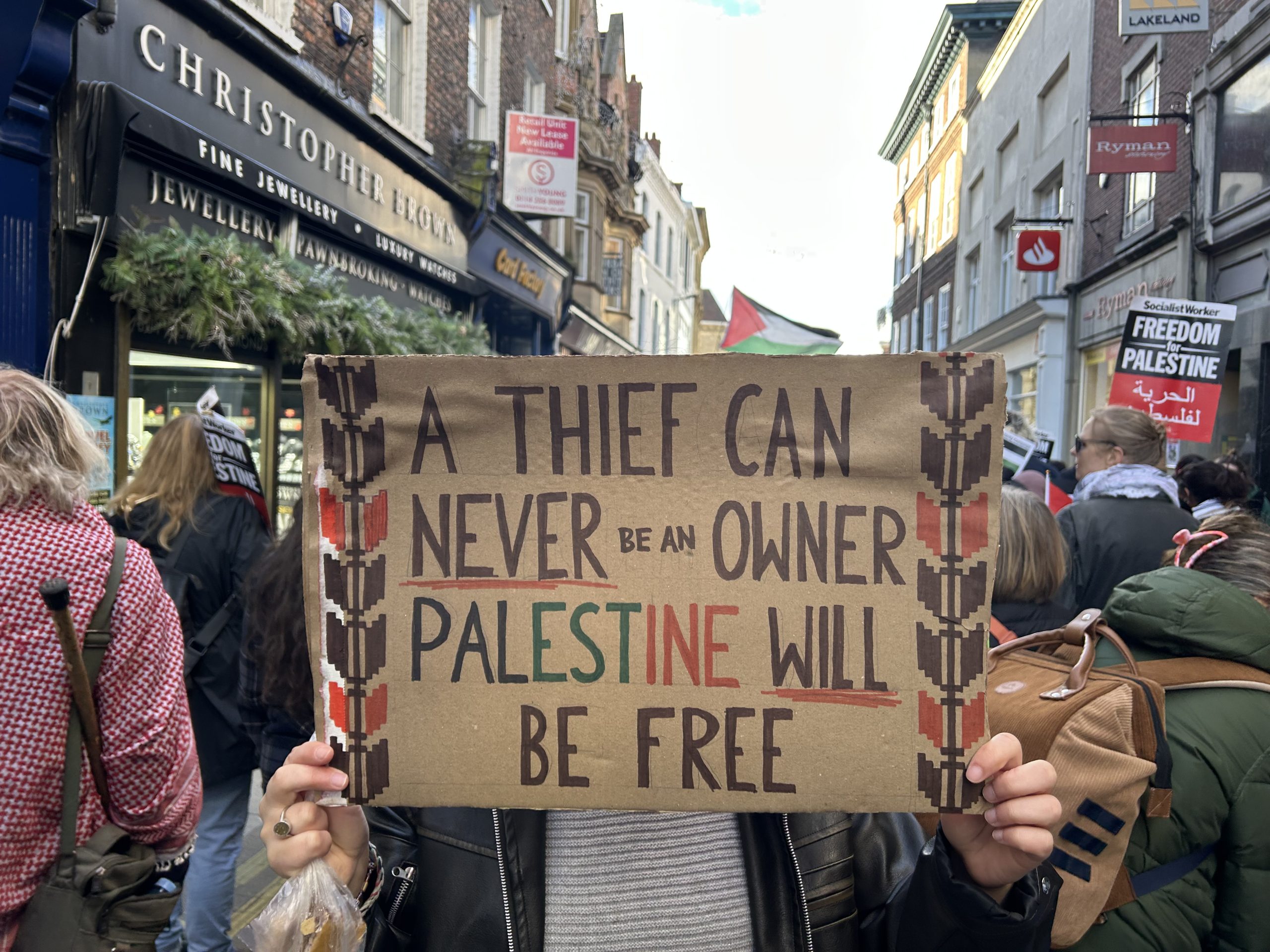
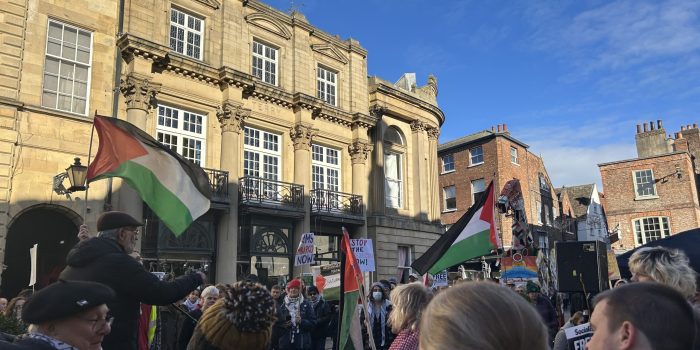
Hundreds gathered in York on Saturday (October 25) to rally for a Free Palestine, pressing local councillors, institutions, and residents to take action on the crisis in Palestine.
The protest, organised by York Palestine Assembly (YPA), began at 11 am in St Helen’s Square, where attendees heard speeches and visited fundraising stalls, before marching around the city centre.
Despite a ceasefire being signed two weeks ago (9 October), YPA says the fight to end Israeli occupation and apartheid in Gaza and the West Bank continues. Over 200 people have been killed since the ceasefire and at least 597 injured.
One speaker stated in their speech that, “the peace deal doesn’t speak of a free Palestine or self-determination”.
YPA’s Five Demands
The demonstration follows YPA’s announcement of five key demands – four directed at York City Council. These include: public recognition of the Palestinian ‘Genocide’ and formal condemnation of Israel; support for justice and liberation; ethical investment and divestment; and visible solidarity such as city twinning and flag raising on remembrance days, as was done for Ukraine.
The final demand, Support for Gaza Students, is aimed at the University of York, who expect three incoming Gazan offer holders. They urge the University to act ‘urgently and compassionately’ to ensure the students can begin their studies ‘in safety and dignity’.
The Day of the March
Before the march began, protesters listened to three opening speeches from Professor Mohamed El-Gomati, one of the founders of York Mosque; Rachell Maskell, the York Central MP and Tom Franklin, the Secretary of York Green Party.
In his speech, Professor Mohamed El-Gomati compared Palestinian journalists to canaries used to warn miners of danger, “300 Palestinian journalists have been murdered, and the Western world can’t get in, so we must trust Palestinian voices,” he declared.
Rachael Maskell spoke about the importance of supporting healthcare workers in Palestine. She recently met with Médecins Sans Frontières (MSF) AND UK Med, who reported that 1,700 healthcare workers had been targeted and killed, while over 185 remain imprisoned by the Israelis. Maskell called for their release saying, “their skills are needed now more than ever.”
Maskell also contended that if we take pride in our healthcare system, we should take Palestinians into our wards and medical schools, “We’ve got the capacity to be able to do that, there is not a single university left in Gaza, they need our help and the time is now”.
Tom Franklin addressed the broader vision of peace in the region, stating, “A true peace is so much more than the absence of war”. He outlined his view of “A free Palestine, as a land from the river to the sea,” which “must allow the right to return for Palestinians; it must allow equality to all who live there, ending apartheid Israel; but it must also allow Jewish Israelis willing to live in peace with their neighbors to remain there.”
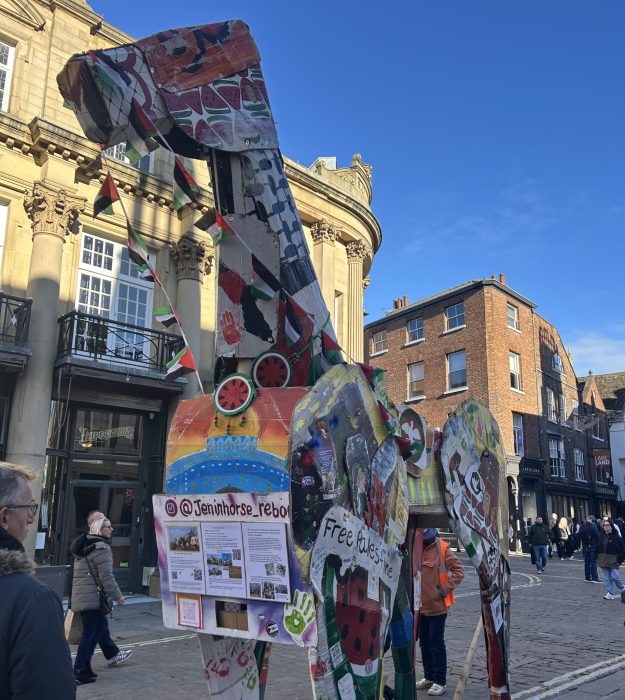
The march was led by a replica of the Jenin Horse sculpture; the original was constructed in 2003 at Jenin Refugee Camp, out of debris left by an Israeli invasion. Despite YPA wardens being on hand to de-escalate any confrontational members of the public, there was also a large police presence in town. Police were seen with cameras directed at the protesters.
The demonstrators marched up Stonegate, along Lower Petergate, through Parliament Square, and down Coney Street – returning to St Helen’s Square, where baked goods and Palestinian food were being sold to raise money.
The demonstration concluded with closing speeches from representatives of Healthcare Workers for Palestine, Stand Up to Racism and York to Gaza.
A spokesperson for Healthcare Workers for Palestine said the group’s actions were motivated by humanity: “We have done all this not because we are activists for a profession, but because we are human beings who refuse to look away.”
The speaker urged protesters to maintain momentum. “This is not the moment to back down, we cannot stop now; not when the silence is still deafening, not when the machinery of violence is momentarily paused but not dismantled, not when the genocide hasn’t stopped, only slowed down.”
The final speaker, condemned what he described as Britain’s complicity in the suffering of the Palestinian people, citing historical turning points, notably the Balfour Declaration, and the UK’s continued provision of financial aid, intelligence, and weapons to Israel.
“Israel doesn’t want peace, it’s still at war, therefore, we must still resist,” he said, calling for boycotts, divestment, government sanctions, and an end to the arms trade. “We need to stop funding the war machine,” he added.