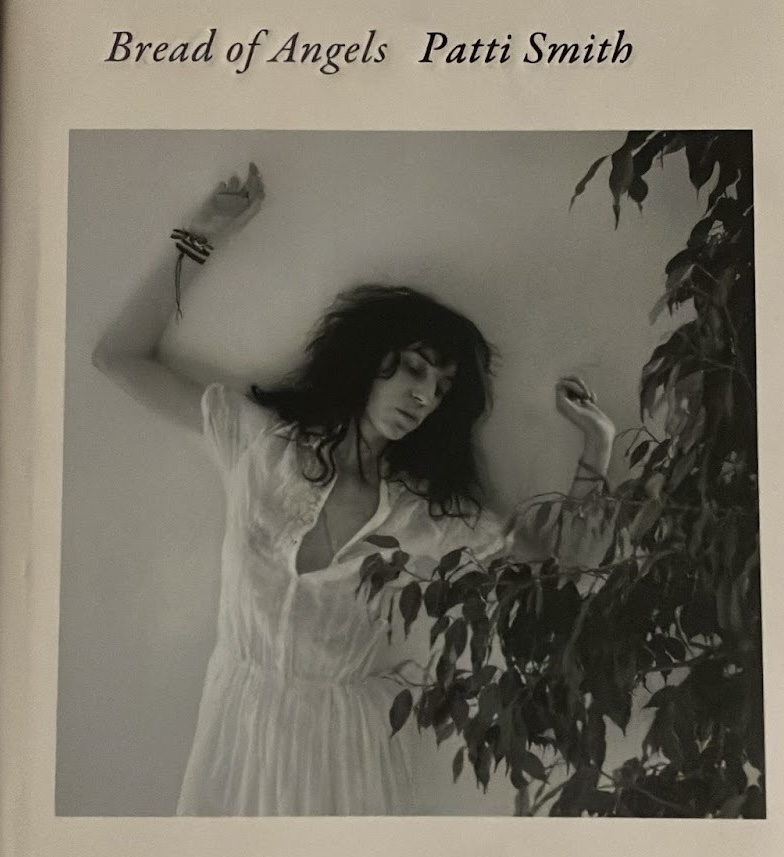
I reached for Patti Smith’s latest memoir with high expectations having read her previous books. She is, in my eyes, our last remaining Beatnik (being mentored by both William S. Burroughs and Allen Ginsberg), which is evident in her poetic and vivid prose. Yet, though her style is consistent with her former works, the 2025 release is a slight disappointment.
Unfortunately, there’s only so much one can write about their own life before they start repeating themself. The beginning of Bread of Angels outlines Smith’s early life, and her experience being a child who had to rely on her own imagination, as she spent large chunks of her childhood stuck indoors recovering from illnesses. This takes up a good portion of the book, yet most of this information was already given to us in her bestselling memoir Just Kids. There were some new details, but reading the opening chapters still felt like a predictable slog for someone who is familiar with Smith’s other works. I imagine if I had gone into this book with fresh eyes, it could have been a true pleasure since Smith’s writing has remained remarkably spell-binding and evocative, but I cannot say that Bread of Angels adds anything truly noteworthy to what she has already told us about her early years.
That being said, the memoir picks up once we get past Smith’s childhood and adolescence. She touches briefly on her musical career and her experiences touring with Patti Smith Group without repeating what we already know. The rest of the memoir is mostly focused on her relationship with Fred “Sonic” Smith (guitarist for MC5) and her life following his death. This is certainly the highlight of her novel. Often in her previous novels her time with Fred is obscured by the painful weight of memory and she does not delve into detail, so this is our first real opportunity to meet Fred closely through Smith’s eyes. The heightened emotions and confusion of grief are expressed delicately and soulfully through Patti Smith’s writing; we get the slightest glimpse into the cavern of loss that looms within all of Smith’s memoirs.
“Smith’s writing has remained remarkably spell-binding and evocative”
Bread of Angles is certainly weaker than Smith’s former works, but it definitely still has merit when reading it in isolation. It lacks the focus and detail of Just Kids, yet also doesn’t follow the style of her books M Train or Year of the Monkey in which she details moments of her adult life with a fever-dream-esque magical realism. However, the latter half of Bread of Angels carries intense emotional weight and is steeped in both pain and strength, and for that I deem this memoir a critical read when tracing Patti Smith’s life. For a lover of Smith’s writing career, this book is both a disappointment and a revelation, so I still implore fans to read it.