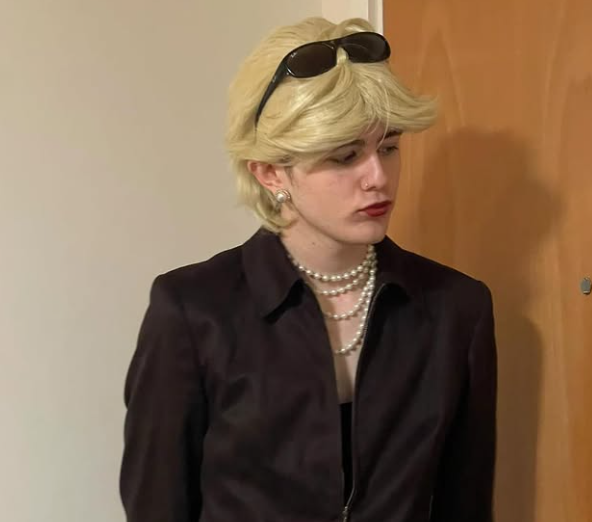
Can you even consider yourself a UoY student if you haven’t drunkenly stumbled into York’s Princess Diana on a night out?
When he’s not kitted out in royal attire, Kian O’Brien is a regular 19-year-old history student at York. But, equipped with an eloquent string of pearls, darkened sunnies and an impassioned resolve to clamp down on hate speech, he transforms Princess Diana. More than just a friendly face on club nights, this social advocate has captured the hearts of York. But beyond all that, Kian wants to remind people that social activism comes in many forms, and that “anything I’m doing right now, anyone can do.”
Who is the York Princess Diana?
@the_york_diana is an act that continues to enlighten, and sometimes enrage, students on campus.
In O’Brien’s own words, he said: “The way I see it, York Diana started from just a joke, just a charity thing. But now it’s become a bit of a movement.”
And this movement has taken Diana to all sorts of places. Her 1k Instagram followers might spot her sipping Green Shits at Stone Roses, handbag in clutch. But she’s also known for making an appearance at more controversial events, passionately waving a sign at the Anti-Reform society protest that took place last year.
But amidst all the chaos, O’Brien always wants to remind people that there is a strong element of delinquent fun and young spontaneity at the heart of it, saying: “it cheers people up to see me on a night out or if I’m having a chat with someone – it’s just like, all like-hearted, it’s a good laugh. But it also brings forward who I view as an important figure and who I think should be remembered.”
Who was Princess Diana?
The real Diana (1961-1997) was the first wife of the current monarch, King Charles III (then Prince of Wales). The much-loved member of the Royal Family was unceremoniously dubbed ‘the People’s Princess’ for her genuinely caring attitude toward numerous philanthropic causes, even against royal discretion.
In stark contrast to the media’s current focus on the royal family, for many, Diana’s beloved character has prevailed, even after death. Alongside her assiduous interests in child terminal illness and homelessness charities, she is better known for the humanising and unprecedented support she showed to people with HIV/AIDS, who faced heavy stigmatisation and social shame at the time.
She stood up for a vulnerable group of people at a time when she wasn’t expected to, at a time when it would have been better (by societal and royal standards) to keep a distance. But Diana was never one to shy away from the cause, famously saying: “HIV does not make people dangerous to know. You can shake their hands and give them a hug. Heaven knows they need it.”
O’Brien spoke very highly of her, saying: “I support the values she believed in of equality and love and compassion.” He told me that everyone has an inspiring person, someone who motivates them. And for him, Diana is that person.
O’Brien’s drag-inspired version of Princess Diana started in Freshers’ Week. “I basically said one day I’d get an outfit, sort of as a bit of a joke. So I got it and did it in Freshers’ Week. But then people loved it! And it sort of just grew from there.”
But for O’Brien, his admiration of the historical figure goes deeper than most. Dealing with relentless homophobia from a young age motivated him to become a role model for others.
O’Brien’s experience dealing with homophobia
“I came out when I was 13,” he shared, “which was a really young age. I had to experience the challenges from a young age, and sort of grow around it.”
“There would be times in school where I’d be pushed or get called the f-slur. And other people wouldn’t really help me out with it. One time in secondary school, I got pushed on the bus, and I went to my wellbeing year representative, and they didn’t really do anything about it.”
According to the Office for Students Statistics, in the academic year 2023-24, approximately 130, 000 full-time undergraduate students identified themselves as either gay, lesbian or bisexual (LGB). This makes up 11% of the total student cohort, an 8% increase from previous academic years. But O’Brien emphasised that it isn’t easy for closeted students to take comfort in this fact.
“Even nowadays, some people who are like 18 or 19 years old won’t come out because they are too scared of the reaction of others. And I know that if I were in their position, seeing someone be open about it, and being that sort of figurehead would encourage me a lot more.”
“I’ve always had these sorts of beliefs before I came to University, where I think everyone is equal and everyone should have an equal footing in life. That’s always been a foundational thing for me, which, like I said, was reinforced by my personal experience.”
During his time at York, O’Brien has done well to channel his personal experience into a public mission against hate speech, particularly through the York Diana’s Instagram account.
“I’ve always had those beliefs, but I think coming to and creating the York Diana has definitely enhanced the impact it can have.”
“If I go out on the street, and I hear someone using a homophobic term or bullying someone, I’m going to call it out.”
“I’ve found that, a lot of the time, you don’t necessarily have to be someone who spreads hate speech to be part of the problem. I think a lot of the issue is being a passive bystander towards it.”
There is, of course, a jovial element to some of the York Diana content. But many of her story reposts carry a poignant humanitarian message. They bring awareness to important international affairs, emphasising the need for more human kindness and sympathy in the world.
But the biggest waves of York Diana’s influence are felt a little closer to home, back to her Yorkshire roots where it all began in a first-year flat kitchen in early September. York Diana has had a far greater impact on fellow York students, helping them feel more comfortable with their own sexuality and embracing their authentic selves.
“I’ve had people message me or come up to me and tell me I’ve inspired me. One person was inspired to start drag,” O’Brien told me.
“I also did a poll on my story where I asked people: ‘what does York Diana mean to you?’, and it was stuff like ‘a voice for the community’, ‘a safe space for LGBTQ+ issues’, ‘honouring Diana’s legacy’. So I think people do recognise the impact of that.”
Dealing with online attacks
But it hasn’t all been tiaras and sparkly heels for O’Brien.
“I think the majority of people on campus definitely support what I’m doing, but, at the same time, there have been critics who will engage with my Instagram page.”
He told me that one student society with strong religious affiliations (external to the University of York) told him that he was going to hell for being gay. On another occasion, he was sent an anti-gay marriage video which claimed that people only turn gay after having been abused during childhood. Once, he even confessed to having heard rumours that someone was threatening to fight him outside Constantine College.
“Of course,” he was quick to clarify, “they’d never actually do that. I can’t think of an instance where something has actually happened in person […] The issue with critics is that they don’t want to say it to me to my face; they want to hide behind their screens.”
“There are definitely groups on campus who don’t like me, but to be honest, I think that’s an encouraging thing. They understand I have that power to start conversations.”
Speaking positively, O’Brien added, “I don’t mind the criticism. I think criticism is good. But I do think a lot of it is hateful. But that sort of just proves my point and emboldens me. And I think I have that responsibility to be that person who takes that on and sort of manifests it, to fight it.”
York’s LGBTQ+ Scene
But on the whole, O’Brien found York to be “quite an accepting city”, especially having grown up in a small village. Several years ago, the University even had its own York Diana Society, before it was sadly put for society adoption in 2023. With 24% of the York student population identifying as lesbian, gay or bisexual, the Office for Statistics indicates that York is somewhat diverse in this aspect, compared to other Russell Group Universities, like Oxford (22%) and Cambridge (19%).
“When I came to York, I was in that environment where I was around more like-minded people (which I couldn’t say the same for when I was at college or secondary school).” Speaking about the LGBTQ+ community in York, he thought: “there is definitely a clear vibrant community here.”
“I do think that genuine work needs to be done. Because when I think of the gay scene, if I go into town, there isn’t really a dedicated gay club, or like a clear space for gay people, necessarily.” The straight-ificiation of historically gay communities, particularly bars and clubs, is a national phenomenon. Spaces that used to purposefully demarcate areas for gay people to congregate – free from persecution and legal discrimination – are being culturally overturned.
“I think there is a gay scene in York, but it needs to be revised. Personally, I don’t think it’s visible enough, bearing in mind that I’m a gay person, so I’ll be engaged with the community anyway.”
“But I think sometimes it’s just about doing more. I know there’s Glitter, but Glitter doesn’t get much attention. Maybe having something like going to York Pride and having the York SU flag or something like that, which shows a sort of unconditional support, might be nice.”
“I’m not necessarily arguing that York or the University isn’t an accepting place for LGBTQ+ people because it definitely is. But I think sometimes it’s just about taking a bit more of that radical stance and sort of doing more about it and emboldening people to stand up for themselves and root out the hatred. Because it’s one thing to speak about it and, you know, just put a flag up. It’s another thing to actively seek out that discrimination.”
The Union Development Officer, Anna Lindberg-Newby and the Equality and Inclusion Officer, Abi Harrison, made the following statement: “We’re really proud of our diverse community at York, and are really keen to look for opportunities to make them feel represented and heard.
“Spaces like Glitter are a great opportunity to do so, and we’re really keen to get more student feedback and engagement on the event. We really want to make it for the students, so anyone who wants to be involved in the planning process would be very welcome to join.” They invited people looking to get involved to get in touch by emailing [email protected].
At the end of the interview, O’Brien confirmed that he has no plans to stop the York Diana. “I think it’ll be something that will always be there. I don’t know if I’ll always stay in York, but the page will always be there. The page is never going down.”
As a final question, I asked him if there was anything that he wanted people to know about The York Diana that they wouldn’t be able to tell from the Instagram account. He said: “I guess it’s the fact that I am just an individual. I’m a student like anyone else. I was never particularly popular in secondary or college. I am not the Students’ Union, I’m not the University body, I’m not the York City Council…it’s difficult for me as an individual to do things about it.”
“But I can offer support, and I can definitely be that sort of safe space. At the end of the day, I’m just an individual. Anything I’m doing right now, anyone can do. And I think the message is that people should be nicer to each other, people should be more light-hearted and just have a bit of fun.”