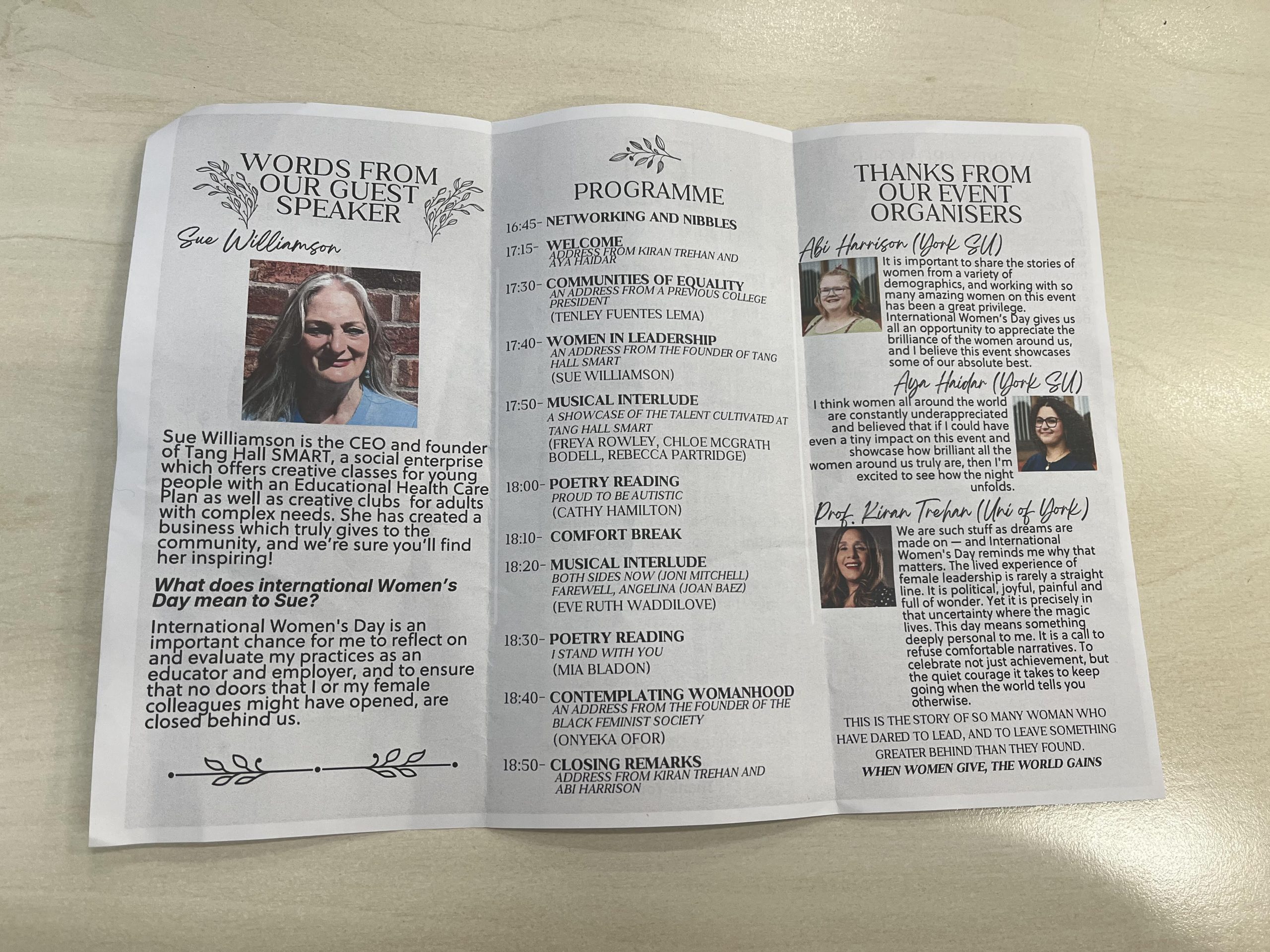
When Women Give, the World Gains. This short proverbial phrase became the driving force for the University of York’s celebration of International Women’s Day (an important addition to anyone’s regular google calendar appointments, I should think).
The day itself falls on the 8th of March. But, inside the antiqued beauty of Heslington Hall, a ticketed event took place four days earlier. Dozens of students, department staff and members of the public alike – from all genders and ethnic backgrounds – fiercely assembled. The end result was truly enlightening.
Attendees experienced a cultural evening, promulgated by the sharing of personal poetry readings and inspiring musical interludes, with the poignant mission to create a space dedicated to celebrating women’s achievements and pioneering discussions on the future of the feminist terrain.
Free leaflets distributed during the 2-hour evening advertised the event as a collaborative affair between the Students’ Union and the University of York, specifically Kiran Trehan (Pro-Vice-Chancellor, Enterprise, Partnerships and Engagement). Their joining did not feel at all out of place, considering the collaboration of strong women was a key cynosure of the event.
The inter-generational spirit, combining both students and staff, was strongly felt by all in attendance. Whilst perhaps not directly intended as such, this generated the additional effect of encouraging interdisciplinary discussions, from a range of voices, during the comfort breaks.
One of the best parts of the events was that it felt like communication and debate were encouraged at every stage. Before, after and during the talks, there were opportunities to engage with like-minded (and occasionally slightly adversarial) voices. At one point in the night, I found myself engaged in what could have been perceived by curious onlookers as something of a curt back-and-forth with one of the other attendees over the definition of a woman. Nevertheless, this event provided the perfect opportunity to discuss these issues and voice such contentions.
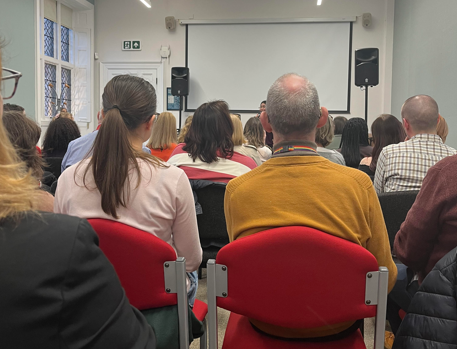
In terms of the speakers themselves, the panel was as varied as those in attendance. In their respective introductory remarks, Kiran Trehan encouraged women to be creative and stop hiding in the shadows of self-defining cages. This is often seen through the self-inflicted use of gender-specific, debilitating language, such as using the word “bossy” to describe women, but never their male counterparts, in leadership positions. She emphasised the urgency for women to shed the uncomfortable narratives which have so far kept them hidden.
Some of her remarks seemed a little misjudged at times. I got the impression that she was more focused on passing the buck, shifting the blame to the female individuals who still make use of this self-deprecatory language in modern times, rather than pointing the blame at the patriarchal system responsible for curating this normalised way of speaking. But her closing dictum: “when women give, everyone gains. Today is about the stories of women who dare to dream and lead” conveyed a nice sentiment, overshadowing her earlier fumble.
In the Students’ Union corner, the Academic Officer Aya Haidar recounted the importance of the relative struggles and accomplishments of women who have come before. She spoke highly of her grandmother in particular, expressing a profound gratitude to the women who have paved the way for a brighter future, and no doubt, experienced womanhood in a way that is both outwardly estranged, yet fundamentally consistent, with our current grasp of it.
Speaking about their experiences running student societies, the founder of Black Feminist Society, Onyeka Ofor, spoke about her personal experience with the women’s movement, and how she sees race and gender as interacting entities. She reflected that, during her time in school, she mistakenly perceived the feminist movement through a very linear lens, pointing to the Suffragettes’ movement as one example. Since then, she has come to realise the ever-demanding need for feminism, especially in parts of the world where women are still judged as second-class citizens, and young girls are at risk of falling victim to infanticide, or being forced into marriage and deprived of education. “It is truly sobering,” she told us.
Speaking briefly, the Lord Mayor of York spoke about the importance of understanding feminism as a cause that involves everyone, as a plight in which every human being – regardless of their gender identity or the nuance of their political affiliations – should strive to make progress. His off-handed suggestion that the idiomatic phrase “behind every man, is an even greater woman’ should be swapped to say “before every man, there is an even greater woman” was met with many nods of approval from the crowds.
One key takeaway from the event was the essentiality of female role models in driving structural change. Hearing the founder of the Tang Hall-based community centre, Tang Hall Smart, which provides critical support for homeless and disadvantaged children, was a great example of this.
But more generally, there was a recurrent theme among all the speakers that we – the women in the audience – have to become role models. We must become the change we want to see in the world, and become the next leaders of feminism as it enters into the next era. A more inclusive and less binary era, as Abi Harrison (York SU’s Equality and Inclusion Officer) made the point beautifully in her touching valedictory.