The concept of romantic connection is one of the main pillars of life, and for many artists, their romantic partners were the source of their inspiration, as Diego Rivera to Frida Khalo, or Francoise Gilot to Pablo Picasso. But for performance artist, Marina Abramovic, her romantic connection did not merely supply the fuel for her art, it became the art.
Marina met fellow artist, Frank Uwe Laysiepen (better known as Ulay) in 1975, and seemed to have an intrinsic connection – they shared the same birthday, were similar in physiognomy, and Ulay himself had said that when they met, he had felt an immediate fascination. The two would begin living together as they produced a series of collaborative performance artworks that would test their endurance, both as individuals and as partners. The series was called ‘Relation Works’ and began in 1976, aiming to explore ideas of the ego, as well as the duality of a romantic relationship through the unification of Marina and Ulay as a singular artistic unit – a kind of third energy. No performance of the series was rehearsed or intended to have any sort of predicted end, which intensified the intimate nature of their relationship to viewers.
The individual performance works of the series are too numerous to mention, but their first performance was ‘Relation in Space’ (1976), in which the couple repeatedly passed by one another without their clothes, occasionally bumping into each other until they eventually went from walking to running, increasing the intensity of the collisions. The performance went on for an hour before a small audience, and though it might seem frivolous, was a trying way of enacting the fusion of male and female energy into this third component.
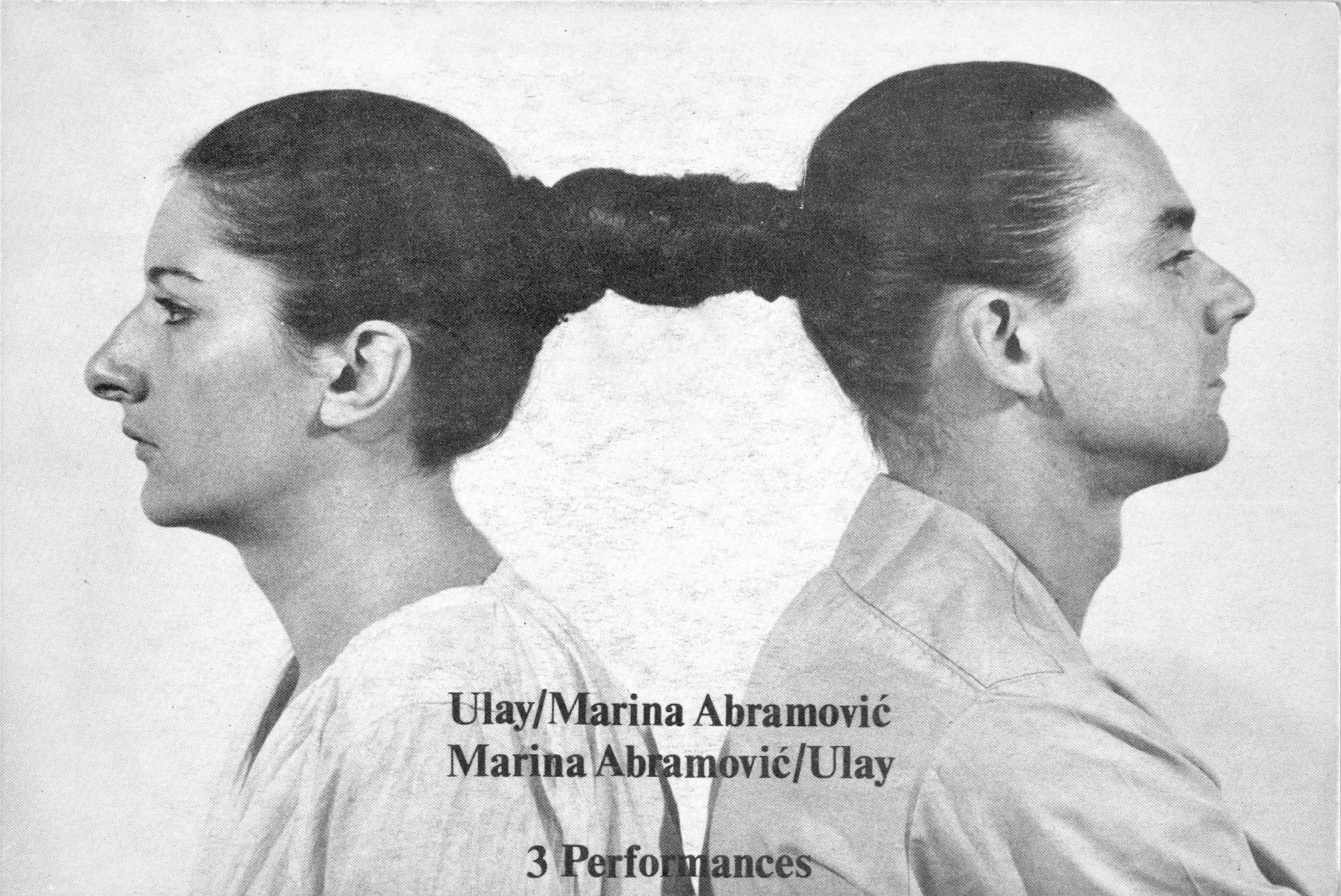
Moreover, the physical strain of this type of endurance art would also elicit heightened emotional reactions from its participants, something that would continue to happen to the couple in their other projects. Another performance, ‘Relation in Time’ (1977) went on for a much longer seventeen hours, and the couple had to sit back-to-back with their hair tied together between them. Their idea was that they would sit for sixteen hours in a gallery space, pushing themselves to the point where they were close to exhaustion, and then members of the public would be allowed in to watch them sit for the final hour.
Marina and Ulay aimed to utilise the energy that the public would bring to their exhausted bodies in order to push themselves to the limits of their abilities, but for the preceding hours, they could rely only on each other for the endurance they needed, taking solace in the simple fact that they both remained there in the space.
Marina and Ulay’s relationship would not ultimately withstand the trials of their work, with Marina committed to her projects, determined to continue learning about themselves and testing their endurance, while Ulay grew uncomfortable with the burgeoning recognition they were receiving.
Amazingly, this still would not mark the end of their work together, as Ulay would make a surprising visit to Marina’s 2010 performance The Artist Is Present, held at the Museum of Modern Art in New York, where she would sit at a table in a period of silence with any stranger who came to sit before her.
The couple had not spoken in some twenty years when Ulay sat down at the table, and Marina initially looked surprised. He shook his head, and she began to tear up, reaching for his hands at the end of the encounter as he leaned in to say something that the deeply moved audience could not hear.
The relationship of Marina and Ulay was not simply a collection of moments and feelings that existed in each of their minds and impassioned them to create artworks about one another. They took a step further, becoming one and creating as one.
Article by: Holly Whitaker (This article has been digitised from print.)