Paula Rego was a Portuguese artist who gained most of her publicity from the late 90s to the early 00s, creating innovative and sometimes unsettling works that certainly do not shy away from political taboos.
She has dedicated multiple pictures to the topic of conflict, one of her earliest works being ‘The Interrogation’, a commentary on the systematic torture carried out by the Portuguese government under the rule of António de Oliveira Salazar. The fact that the faces of the two henchmen standing behind the sufferer are not visible emphasises the inhumanity of this abuse, along with her splayed fingers and twisted limbs which seem to convey pain and anguish to the point of disfigurement. I think that this is perhaps more of an embodiment of the mental effect of torture on the individual.
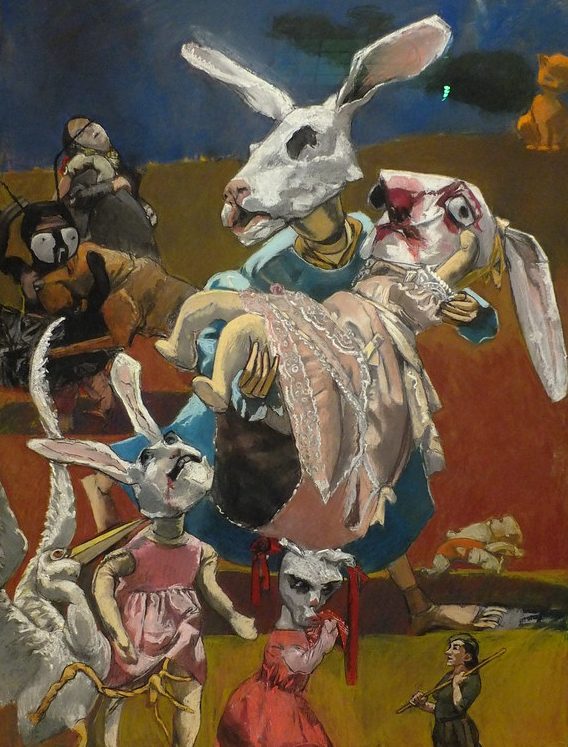
Growing up in Portugal herself with early experience of political injustice, Rego was strongly influenced by the matter in her art and later drew from other conflicts such as the Iraq War in her painting ‘War’. This was a much later piece inspired by photographs of the event featured in newspapers at the time. Similarly to her earlier paintings, Rego does not give faces to most of the people, but the focus instead seems to be on a woman carrying an injured child as other children stand in front of them. It initially seems a rather odd choice to give these people the heads of rabbits, which has been interpreted as how identity is erased as a result of war, but Rego has said “I would do a picture about these children getting hurt… It’s very difficult to do it with humans, it doesn’t get the same kind of feel at all. It seemed more real to transform them into creatures”.
This erasure of human identity could mean we can disconnect from the reality of this extreme violence enough to acknowledge it, otherwise, we would be made too uncomfortable to accept that these kinds of events were taking place, looking at it instead as fantasy or over-exaggeration.
By Holly Whitaker